
Complete Guide to Grow Your Business in 2026
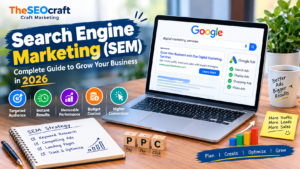
Introduction
In today’s digital age, businesses are constantly looking for ways to reach their target audience quickly and effectively. One of the most powerful strategies to achieve this is Search Engine Marketing (SEM).
SEM allows businesses to appear at the top of search engine results instantly, helping them drive traffic, generate leads, and increase sales. Unlike organic methods, SEM delivers fast results, making it ideal for both small businesses and large companies.
Search engines like Google process billions of searches every day. SEM helps you take advantage of this massive opportunity by placing your business in front of people who are actively searching for your products or services.
What is Search Engine Marketing (SEM)?
Search Engine Marketing (SEM) is a digital marketing strategy used to promote websites through paid advertisements on search engines. It primarily involves Pay-Per-Click (PPC) advertising, where advertisers pay only when someone clicks on their ads.
These ads usually appear at the top or bottom of search engine results pages (SERPs), marked as “sponsored” or “ad.”
SEM is different from SEO (Search Engine Optimization). While SEO focuses on organic rankings, SEM focuses on paid visibility for immediate results.
How Search Engine Marketing Works
SEM operates on a bidding system where advertisers compete for ad placements. Here’s how the process works step by step:
- Keyword Research
You select keywords that your target audience is searching for. - Ad Creation
You create engaging ads with compelling headlines and descriptions. - Bidding
You set how much you are willing to pay per click. - Ad Auction
The search engine runs an auction to decide which ads appear. - Ad Display
Your ad appears on the search results page. - Pay Per Click
You pay only when someone clicks on your ad.
Platforms like Google Ads make it easy to create, manage, and optimize SEM campaigns.
Key Components of SEM
1. Keyword Research
Choosing the right keywords is the foundation of a successful SEM campaign. You need to target keywords that have high search volume and strong user intent.
2. Ad Copywriting
Your ad copy must be clear, engaging, and persuasive. A strong call-to-action (CTA) can significantly increase your click-through rate (CTR).
3. Landing Pages
A well-optimized landing page ensures that visitors take action after clicking your ad.
4. Bidding Strategy
Choosing the right bidding strategy helps you control costs and maximize results.
5. Quality Score
Search engines evaluate your ad quality based on relevance, CTR, and landing page experience. A higher quality score can reduce your cost per click.
Types of Search Engine Marketing Ads
1. Search Ads
These are text-based ads that appear on search engine results pages.
2. Display Ads
Visual ads that appear on websites within the search engine’s network.
3. Shopping Ads
Used by eCommerce businesses to showcase products with images and prices.
4. Video Ads
Ads that appear on video platforms and search results.
Each type serves a different purpose and helps businesses reach their audience effectively.
Benefits of Search Engine Marketing
SEM offers several advantages that make it a powerful marketing strategy:
Instant Results
Unlike SEO, SEM provides immediate visibility and traffic.
Targeted Audience
You can target users based on keywords, location, device, and more.
Measurable Performance
You can track clicks, impressions, conversions, and ROI.
Budget Control
You can set daily budgets and control spending easily.
High Conversion Rates
Since users are already searching for your product, they are more likely to convert.
SEM vs SEO: Key Differences
| Feature | SEM | SEO |
|---|---|---|
| Type | Paid | Organic |
| Results | Instant | Long-term |
| Cost | Pay per click | Free traffic |
| Strategy | Ads | Content + optimization |
| Speed | Fast | Slow |
👉 The best strategy is to combine both SEM and SEO for maximum results.
Essential Tools for SEM
To run successful SEM campaigns, you need the right tools:
- Google Ads
- Google Analytics
- SEMrush
These tools help you analyze performance, track conversions, and optimize campaigns effectively.
How Search Engine Marketing
If you’re a beginner, follow these steps to get started:
- Create an account on Google Ads
- Conduct keyword research
- Set your campaign goals
- Create high-quality ads
- Set your budget and bids
- Launch your campaign
- Monitor and optimize regularly
Consistency and testing are key to success in SEM.
Common SEM Mistakes to Avoid
Many beginners make mistakes that waste their budget. Here are some common ones:
- Choosing the wrong keywords
- Ignoring negative keywords
- Writing poor ad copy
- Sending traffic to unoptimized landing pages
- Not tracking conversions
Avoiding these mistakes can improve your campaign performance significantly.
Future of Search Engine Marketing
SEM is constantly evolving with new technologies and trends. Some important trends include:
- AI-powered ad optimization
- Voice search advertising
- Automation and smart bidding
- Personalized ads
Businesses that adapt to these changes will stay ahead of the competition.
Conclusion
Search Engine Marketing (SEM) is one of the fastest and most effective ways to grow your online presence. It allows businesses to reach their target audience instantly and generate measurable results.
Whether you’re a beginner or an experienced marketer, SEM can help you achieve your business goals when used correctly. By combining SEM with SEO, you can build a powerful digital marketing strategy for long-term success.
🔥 SEO Meta
Meta Title:
Search Engine Marketing Guide 2026 | SEM Strategy, Tools & Benefits
Meta Description:
Learn search engine marketing (SEM), how it works, benefits, tools, and strategies to drive instant traffic, leads, and sales in 2026.